In this blog

Need a design partner that scales with you?
See exactly how Design Shifu can become your on-demand design team. Book a free demo call.
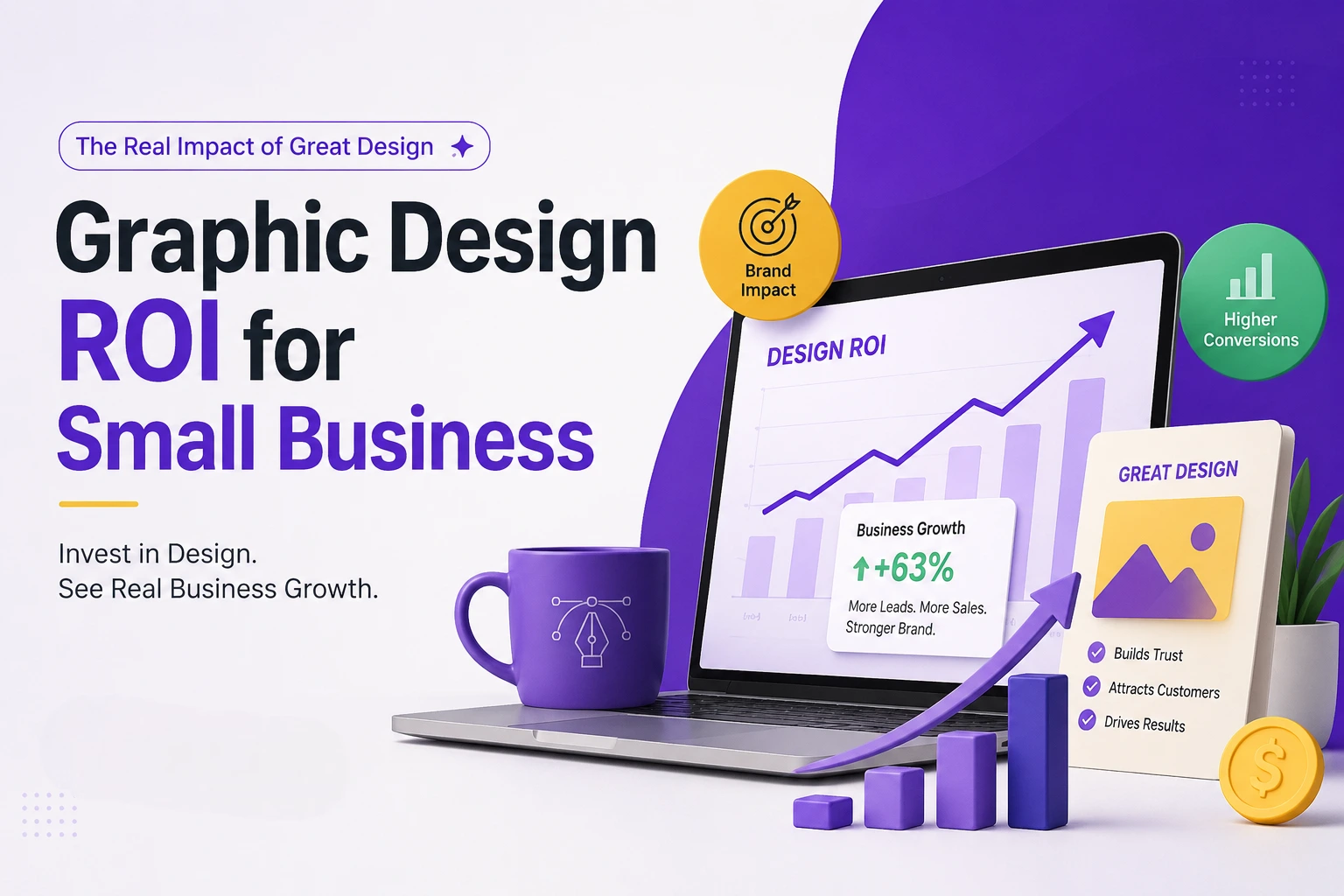
Your designer just sent an invoice. Your social media graphics look great. Your website got a refresh six months ago. But when your accountant asks what you're actually getting back from your design spend, you go quiet. That's not a problem. Most small businesses have no system for measuring graphic design ROI, so they either cut the budget when times get tight (wrong) or keep spending without knowing what's working (also wrong).
This guide gives you a practical framework for measuring what your design budget is actually returning, in plain language, with real math you can show anyone.
Does Graphic Design Actually Drive ROI for Small Businesses?
Yes. And the evidence isn't close.
McKinsey's Business Value of Design report tracked 300 companies over five years and found that design-led businesses grew revenues 32% faster and delivered 56% higher shareholder returns than industry peers. That's not a small edge, it's a consistent, repeatable advantage.
Forrester's Total Economic Impact research found that every $1 invested in UX and design returns approximately $100. That's a 9,900% ROI across companies that treat design as a business function, not an expense.
For small businesses, the numbers are more modest but the logic is the same. Better-designed ads get clicked more often. Better-designed landing pages convert more visitors. Better-designed emails get opened and acted on. Every one of those outcomes is measurable, if you set up the right tracking.
What Metrics Should Small Businesses Track for Graphic Design ROI?
The competitor article this post is designed to beat lists 30+ metrics across three categories. That's overwhelming and impractical for a small team. Here's what actually matters:
- Time savings
How much time does your team spend producing, revising, or recreating design assets? Every hour saved is money saved. Track design hours per deliverable before and after changing your design process, then multiply by your team's hourly cost. - Conversion rate lift
This is the most direct design ROI metric for small businesses. A better-designed landing page, ad creative, or email template converts a higher percentage of visitors into customers. Even a 1% lift on high-traffic pages moves the needle significantly. - Customer satisfaction
Satisfied customers stay longer, buy more, and refer others. Nielsen Norman Group research consistently shows that usability improvements directly increase customer satisfaction scores, which in turn drive revenue retention. - Direct revenue impact
This one takes a little setup, but it's the most convincing metric for any stakeholder. Track revenue per visitor before and after a redesign. Run A/B tests on ad creatives. Compare email revenue between two campaigns with different visual approaches.
You don't need to track all four perfectly from day one. Pick one, establish a baseline, and measure for 90 days. That alone puts you ahead of 90% of small businesses.
How to Calculate Graphic Design ROI (Step-by-Step)
The formula is simple:
Here's a worked example. You're spending $500/month on a design subscription. Your website generates $50,000/month in revenue. You redesign your product pages with new imagery and clearer CTAs.
If your conversion rate goes from 2.0% to 2.1%, a 0.1% improvement and your average order value is $200, that's 50 additional conversions per month at $200 each = $10,000 extra revenue.
(10,000 − 500) ÷ 500 × 100 = 1,900% ROI
That's not a made-up number. That's what a single, well-executed redesign can return on a modest-traffic site. The math gets even more favorable as traffic scales.
A SaaS startup using Design Shifu scaled to 5x their monthly design output while cutting design costs by 60% compared to what they'd been paying freelancers. More assets produced at lower cost meant more campaigns running, more creative variations tested, and faster iteration on what worked.
The key is having a fixed, predictable design cost which is why a design subscription makes the ROI calculation much cleaner than working with freelancers, where costs fluctuate wildly per project.
What Is the HEART Framework and How Do Small Businesses Use It?
The HEART framework was developed by Google's UX research team as a structured way to measure user experience at scale. Small businesses can use it to tie design decisions to measurable outcomes without a data science team.
HEART stands for:
- H — Happiness: How satisfied are your customers with your product or marketing experience? Measure with CSAT surveys, NPS scores, or post-purchase review ratings. Aim to capture this before and after a redesign.
- E — Engagement: How often do users interact with your content or product? For marketing design, this means email open rates, time on page, social media interactions, and return visit rates.
- A — Adoption: Are new users or customers successfully completing key actions? For e-commerce, this is the checkout completion rate. For SaaS, it's feature activation within the first session.
- R — Retention: Are your customers staying? Churn rate and repeat purchase rate are the clearest signals. Consistent, professional visual branding directly supports retention, customers trust what looks credible.
- T — Task success: Can users do what they came to do? Think conversion rate, form completion rate, and search-to-purchase rate. Clear design reduces friction. Less friction = more task completion.
How to Use the HEART Framework to Measure Design Impact
You don't need to track all five from the start. Pick the two or three that map to your biggest business problem right now. A high-churn SaaS product starts with Retention and Happiness. A low-converting e-commerce store starts with Adoption and Task Success.
For more on maintaining the brand consistency that supports Retention scores, How to Maintain Brand Consistency Across All Channels is a practical place to start.
How to Present Design ROI to Stakeholders
The mistake most small business owners and designers make: they show outputs ("we made 12 graphics this month") instead of outcomes ("our email click rate went up 18% after the template redesign").
Decision-makers don't care about deliverables. They care about business results.
Here's the one-page format that works:
- The baseline — what was the metric before the design change?
- The change — what design work was done, and when?
- The outcome — what happened to the metric after?
- The dollar value — translate the outcome into revenue or cost savings
- The cost — what did the design work cost?
- The ROI — the formula from the section above
Keep it to one page or one slide. Use one number as the headline ("Our landing page redesign returned 14x its cost in 90 days"). Then let the table tell the rest of the story.
What Tools Help Track Graphic Design ROI for Small Businesses?
You don't need enterprise software. Here's what works at small business scale:
- Google Analytics 4 — Free, tracks conversion rates, goal completions, and revenue per session. Set up before-and-after date comparisons when you launch a redesign.
- Hotjar or Microsoft Clarity — Free heatmap and session recording tools. Show exactly where users click, scroll, and drop off. Invaluable for proving that a design change fixed a specific friction point.
- Mailchimp or Klaviyo — Built-in A/B testing for email design. Run two versions of the same email with different visual layouts and let the data pick the winner.
- Google Optimize (or VWO) — Run A/B tests on landing page design. Measure conversion rate directly against a control version.
- A simple spreadsheet — Don't underestimate this. A monthly tracking sheet with your key metrics, design spend, and revenue takes 15 minutes to maintain and gives you a clear picture over time.
The biggest mistake is not starting because you don't have the "right" tools. Start with Google Analytics and a spreadsheet. Add tools as your tracking needs grow.
Start Measuring Instead of Guessing
Most small businesses treat design as a cost. The ones that grow treat it as an investment and they measure it like one. You don't need a complicated analytics stack. You need a baseline, a metric, and a design partner who can produce work fast enough to test and iterate.
Design Shifu gives small businesses a dedicated design team for a flat monthly fee, unlimited revisions, fast turnaround, and no freelancer roulette. That predictable cost makes your ROI math clean. Check pricing to see what fits your budget.
FAQ
How do I calculate the ROI of graphic design?
Use this formula: ROI = (Revenue Gained − Design Cost) ÷ Design Cost × 100Track changes in conversion rates, revenue, or time savings before and after a design update.
What does "graphic design ROI" actually mean for a small business?
It means measuring what you get back in time, money, or customers relative to what you spend on design. It's no different from measuring the ROI of any other business expense. The inputs are your design cost and the metric you're tracking; the output is whether the spend is generating more than it costs.
Can I outsource design and still measure ROI?
Yes, and outsourcing often makes it easier. When design is handled by a dedicated team, you get consistent output on a predictable timeline, which makes before/after comparisons cleaner. How to Outsource Graphic Design the Right Way covers how to set this up properly.
What's the fastest way to start measuring design ROI if I haven't tracked anything before?
Pick one metric, establish this month's baseline, and track it for 90 days. The easiest starting point is email click rate or landing page conversion rate, both are visible in free tools and directly tied to design quality. Don't try to track everything at once.
How do I know if my design is actually affecting conversions?
Run an A/B test. Create two versions of the same page, ad, or email one with the old design, one with the new. Send equal traffic to both and measure which converts better. Most email platforms and Google Optimize make this straightforward.
Is hiring a freelance designer or using a design subscription better for ROI?
From a pure ROI-tracking standpoint, a subscription is easier to work with your design cost is fixed and predictable every month, so the denominator in your ROI formula never changes. Freelancer costs vary per project and per revision, making it harder to measure consistently. See Freelance Designer vs. Design Subscription for a full comparison.
What's a good ROI for graphic design spending?
For conversion-focused design (landing pages, ad creatives, email templates), a 5–10x return on design cost within 90 days is achievable for most small businesses. Brand and identity design takes longer to show ROI but has compounding returns stronger brand recognition reduces customer acquisition costs over time.
About the author

Sameena is an Organic Growth Specialist and Content Writer at Design Shifu, crafting SEO-driven content that boosts visibility, builds brand authority, and drives meaningful organic growth.