In this blog

Need a design partner that scales with you?
See exactly how Design Shifu can become your on-demand design team. Book a free demo call.
Hiring a designer sounds simple until you see the real bill.
Most teams only budget for the salary. But between recruiting fees, software licenses, paid leave, hardware, and the weeks a designer isn't actually designing, the true annual cost of an in-house hire regularly lands between $90,000 and $150,000+.
Subscription-based design services pitch a different model: a professional team, unlimited revisions, 24-hour turnaround, and a flat monthly rate. But is the cost comparison really that stark? And when does each model actually make sense?
This guide breaks it all down including the option most comparisons ignore: freelancers.
Let’s break it down
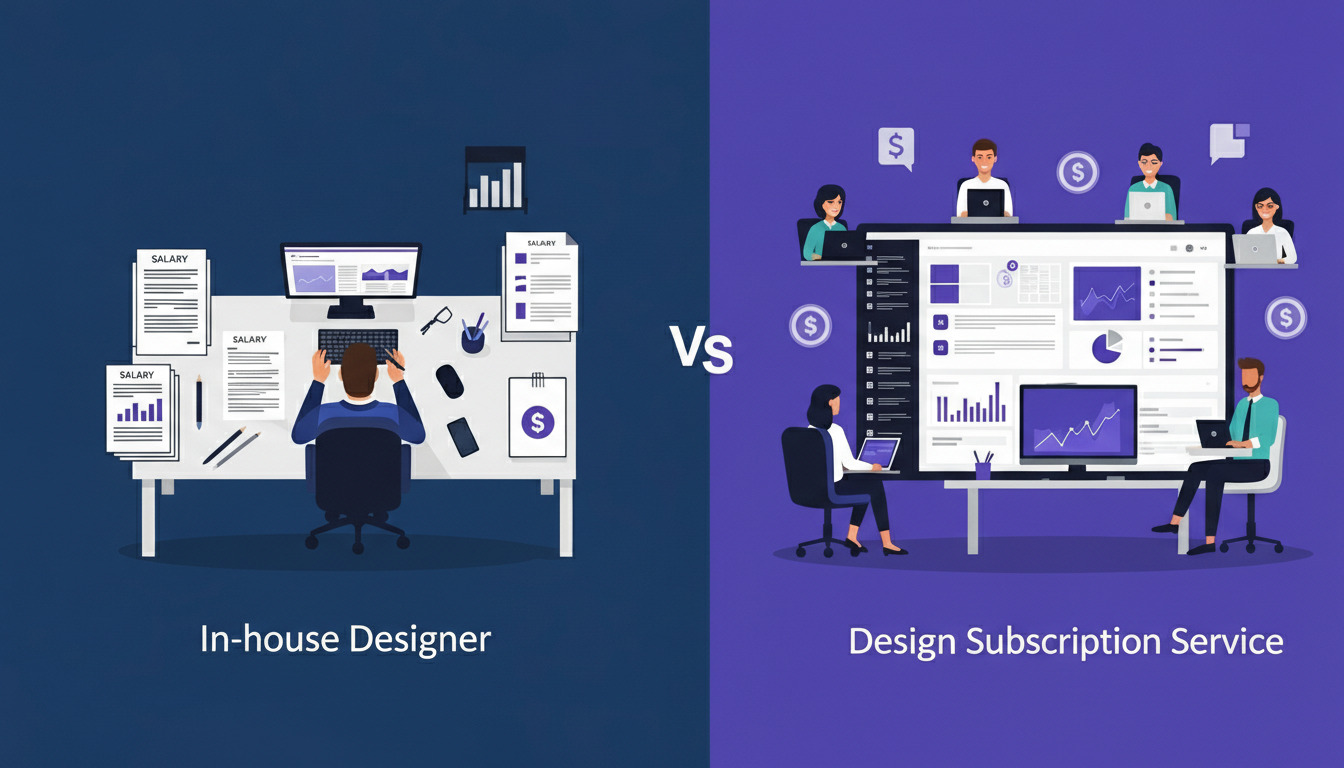
In-House Designer vs Design Subscription: Key Differences
Cost Comparison
Feature Comparison
What Is an In-House Designer?
An in-house designer is a full-time employee dedicated to your brand — handling social media, ads, web, presentations, packaging, and more. They sit in your team, absorb your brand guidelines, and collaborate directly with marketing, product, and sales.
That closeness is genuinely valuable. In-house designers become an extension of your brand brain. The problems start when you look at what that proximity actually costs.
The Real Cost of an In-House Designer (Beyond Salary)
Most teams only think about salary. That’s just the beginning.
1. Salary Costs
According to the U.S. Bureau of Labor Statistics, the median annual salary for graphic designers in the United States is over $60,000 with experienced designers earning significantly more.
In competitive markets, salaries often range from $70,000–$120,000+ per year.
2. Hidden Costs Nobody Talks About
- Recruitment & hiring fees
- Paid leaves, sick days, holidays
- Design tools (Adobe, Figma, stock assets)
- Hardware (laptop, monitor, accessories)
- Training & upskilling
- Management time
- Downtime when workload is low
Recruitment platforms like Indeed show that hiring timelines for creative roles can stretch several weeks, adding both opportunity cost and recruiting expenses.
Reality check: Your designer isn’t designing 8 hours a day, every day.
What Is a Freelance Designer?
A freelance designer works project-by-project, typically at an hourly or per-project rate. They're faster to hire than a full-time employee and lower commitment than a subscription but with their own set of trade-offs.
Typical freelance rates:
- Junior (0–3 years): $25–$50/hour
- Mid-level (3–6 years): $50–$100/hour
- Senior / specialist: $100–$200+/hour
For a team needing 20–30 design tasks per month at a mid-level rate, that's:
- 20 tasks × 3 hours average = 60 hours/month
- At $75/hour = $4,500/month = $54,000/year
And that's assuming consistent availability, clear briefs, and no revision rounds.
The real freelance risks:
- Ghosting mid-project (it happens more than you'd expect)
- Variable quality when a "specialist" is out of their depth on a different task type
- No brand memory — every new project starts from scratch
- Rates increase as your dependency grows
- No structured SLA for turnaround time
Freelancers work well for occasional, clearly-scoped work. They get expensive and unpredictable the moment you have consistent, high-volume needs.
What Is a Subscription Design Service?
A design subscription gives you access to a professional design team for a fixed monthly fee.
You can:
- Submit unlimited design revisions
- Get fast turnarounds (24–48 hours)
- Revise until satisfied
- Scale up or pause anytime
No hiring. No contracts. No long-term risk.
Cost of a Design Subscription
Typical pricing ranges:
- $300 – $700/month (global averages)
That’s often 70–80% cheaper than hiring in-house.
What Does That Cost Per Design?
If you need 20–30 design requests per month, the effective cost per design looks very different:
- In-house: ~$250–$500 per task
- Subscription: ~$20–$50 per task
When you break it down this way, the difference becomes dramatic. You're not just paying for a salary, you're paying for output, efficiency, and scalability.
For growing teams with fluctuating design needs, this cost-per-task comparison makes the financial advantage clear. Over 12 months, that difference can translate into tens of thousands of dollars in savings without sacrificing turnaround speed.
When an In-House Designer Makes Sense
An in-house designer may be worth it if:
- You need daily, high-volume design work
- Your brand requires deep creative ownership
- You’re a large enterprise with stable budgets
- You need real-time collaboration every day
Even then, many companies still combine in-house + subscription to handle overflow work.
When a Design Subscription Is the Smarter Choice
A subscription model is ideal
- If you’re running an agency managing multiple clients, a subscription model keeps design production predictable and profitable. We’ve explained the benefits of unlimited graphic design in detail in our guide for boutique agencies.
- Startups especially benefit from a subscription-based design model that removes hiring risk while keeping branding consistent during rapid growth.
- Your design needs fluctuate
- You want speed without long-term commitment
- You need multiple design skills (social, web, ads, motion)
- You want to control costs without compromising quality
For most modern teams, this is the sweet spot
The Hidden Advantage of Subscription Design
Beyond cost, subscriptions offer:
- Faster turnaround
- Access to specialized designers
- No burnout or dependency on one person
- Easy scaling during launches or campaigns
- Predictable monthly expenses
Some teams consider hiring individual designers before committing to a subscription after all, freelancers might appear cheaper at first glance. However, freelance rates can vary widely depending on experience and workload, and ongoing design demands can quickly make hourly pricing less predictable. For a deeper side-by-side comparison of freelancer costs vs a subscription model, check out our detailed guide on Design Shifu vs Freelancers
In 2026’s fast-moving marketing world, flexibility beats headcount.
Final Verdict: Which Should You Choose?
If you're deciding whether to hire a designer vs subscription services, the answer depends on how predictable your design needs are and how much flexibility your business requires.
If you want maximum control and have a big budget, go in-house.
If you want speed, flexibility, and serious cost savings, a design subscription wins hands down.
For most growing businesses, subscription design delivers more value with less risk.
Ready to Cut Design Costs Without Cutting Quality?
Instead of spending lakhs on hiring, try a design subscription that scales with you, no contracts, no downtime, no drama.
FAQ
Is hiring an in-house designer cheaper than a design subscription?
In most cases, no. The true in-house designer cost includes salary, benefits, software, equipment, and downtime. A design subscription typically offers predictable monthly pricing and can be significantly more cost-effective for businesses with fluctuating design needs.
What is the average graphic designer salary in the US?
The average graphic designer salary in the US ranges from $60,000 to $90,000 annually, depending on experience and location. Senior designers and specialists can earn well over $100,000 per year, especially in major cities.
How much does a design subscription cost per month?
Design subscription pricing typically ranges from $300 to $700 per month for standard plans. Pricing may vary depending on turnaround time, scope of services, and access to specialized designers.
What is the difference between unlimited graphic design and hiring an employee?
When comparing unlimited graphic design vs employee hiring, the main differences are flexibility and scalability. An employee is a fixed cost, while a subscription model allows you to scale up, pause, or adjust services without long-term hiring commitments.
When should a company hire an in-house designer?
Hiring an in-house designer makes sense if your company has consistent, high-volume design work that requires daily collaboration and deep brand ownership. Large enterprises with stable budgets often benefit from a dedicated internal creative team.
Is a design subscription better for startups and small businesses?
Yes, for many startups and SMBs, a subscription-based design model offers lower risk, faster turnaround, and predictable costs. It allows growing teams to access professional design support without the long-term expense of full-time hiring.
About the author

Sameena is an Organic Growth Specialist and Content Writer at Design Shifu, crafting SEO-driven content that boosts visibility, builds brand authority, and drives meaningful organic growth.
.webp)