In this blog

Need a design partner that scales with you?
See exactly how Design Shifu can become your on-demand design team. Book a free demo call.
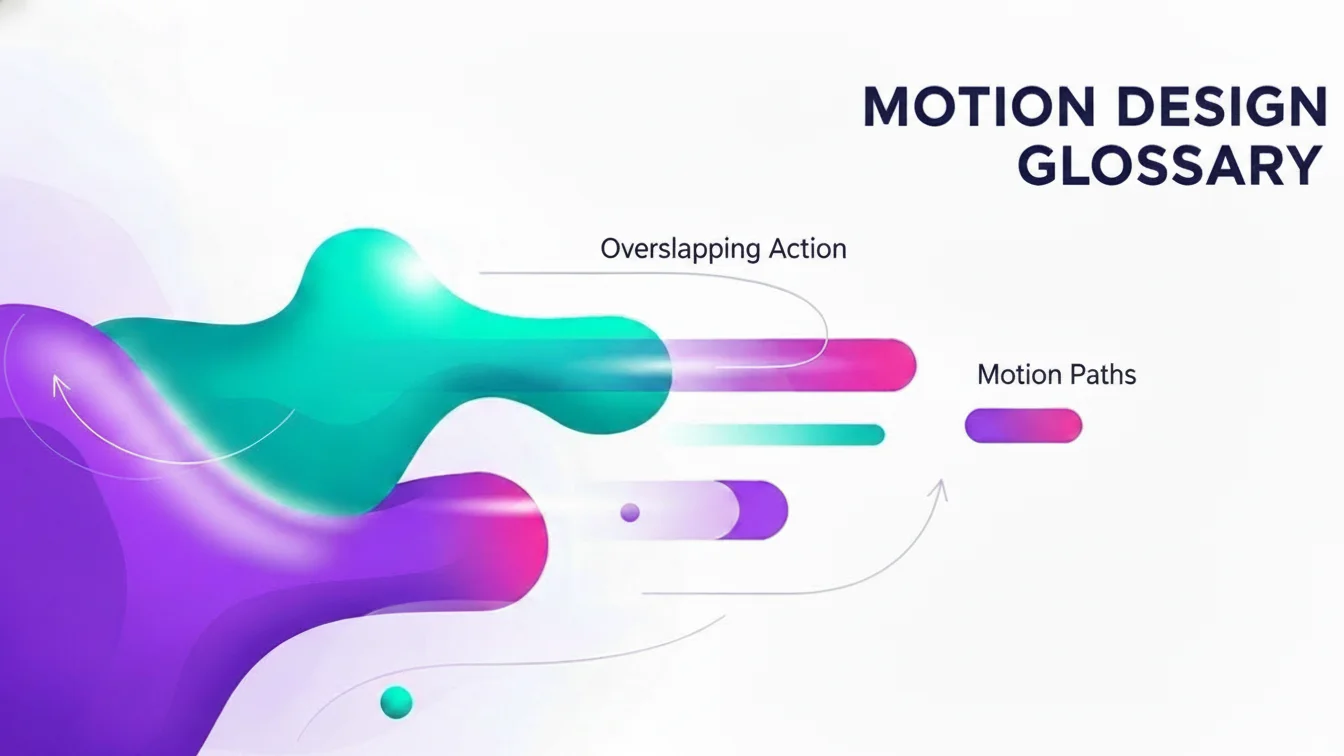
If you've ever opened After Effects and felt like you were reading an alien language, you're not alone. This motion design glossary was created to help you make sense of the layers (literally), timelines, graphs, and technical terms that can overwhelm even seasoned creatives.
Whether you’re a newbie learning the ropes or a pro looking to refresh your terminology, this ultimate motion design glossary breaks down the most important terms used in animation, compositing, and motion graphics especially within Adobe After Effects. Many of these techniques are widely used in motion graphics services to create engaging visuals for brands and marketing campaigns
New to design terminology in general? Explore our Graphic Design Glossary for essential concepts that complement motion and animation work.
Let’s decode the vocabulary and make your motion design workflow smoother and smarter.
TL;DR
- This glossary includes 60+ must-know terms in motion design, categorized by tools, techniques, effects, animation principles, and After Effects features.
- You’ll find clear definitions for concepts like keyframes, easing, 3D space, precomposing, blending modes, squashing/stretching, and much more.
Tools & Panels
Composition Panel
Your main animation workspace in After Effects. It’s the preview window where you view and build your animated sequences.
Project Panel
Located below the Tools panel, this is where you import, search, and organize all your assets like video, audio, and image files.
Timeline Panel
One of the core panels used to manage layers, keyframes, effects, and transitions over time.
Graph Editor
Lets you fine-tune animation speed and movement by visualizing and editing value graphs or speed curves of keyframes.
Presets Panel
A library for storing and reusing animation presets keyframes, effects, and expressions bundled together.
Preview Panel
Used to allocate RAM and play back video/audio in real-time. Playback speed depends on your system's memory.
Layers, Shapes & Masking
Null Object
An invisible layer used as a parent for controlling multiple layers simultaneously.
Shy Layer
A way to hide selected layers in the Timeline to simplify your view without deleting them.
Shape Tool
Allows you to draw vector shapes (circles, rectangles, etc.) directly onto a shape layer.
Pen Tool
Used to create custom shapes or draw masks that define visible and invisible areas of a layer.
Layer Masks
Grayscale images applied to layers white areas are visible, black are hidden, and gray is partially transparent.
Track Mattes (Mattes)
Elements like shapes or text used to control the transparency of another layer below it.
Opacity
Determines how transparent or opaque a layer appears. Lower values = more transparent.
Animation Concepts
Animation involves a mix of timing, spacing, physics, and visual principles that every motion designer must understand. If you want to explore even more creative terminology beyond animation, check out our Complete Design Glossary, which covers essential concepts across branding, layout, typography, and digital design.
Keyframe (implied in context like easing)
A marker on the timeline that defines specific values at a point in time for an animation.
Easing
Slows an object as it approaches or exits a keyframe. “Ease in” and “ease out” create smoother, more natural motion.
Want to explore easing in more detail? Adobe offers an excellent after effects user guide that walks you through how motion is calculated between keyframes.
Slow In and Slow Out
Refers to acceleration and deceleration in motion to mimic realistic physics.
Follow Through
Animation principle where connected parts of an object continue to move after the main body stops.
Overlapping Action
Different parts of an object move at different rates, adding realism.
Pose to Pose
Animation method where key poses are created first and then filled in with in-between frames.
Straight-Ahead Action
Opposite of pose-to-pose. You animate frame-by-frame from beginning to end for spontaneous movement.
Squashing
Exaggerates the impact and elasticity of a moving object, often paired with "stretching."
Staging
Directing the viewer’s attention through framing, pose, and motion within a scene.
Want to deepen your understanding of motion-design fundamentals like squash & stretch, timing, anticipation, and staging? Check out this thorough guide from NYFA on the 12 Principles of Animation.
Rule of Thirds
A compositional guide that helps align subjects along a 3x3 grid to make scenes more dynamic.
Camera, 3D & Perspective
Camera Layer
Simulates real-world camera effects like pans, depth of field, and zoom within 3D compositions.
3D Space
Activates three-dimensional movement and control for layers, allowing Z-axis motion.
Field of View (FoV)
The extent of the visible scene captured by the camera at once. Affects how wide or narrow your shot appears.
Depth of Field
Controls how much of a scene is in focus used for blurring backgrounds or emphasizing subjects.
Perspective
Gives your composition a sense of spatial depth using horizontal and vertical transformations.
Focal Point
The main area of interest in your visual composition.
Foreground / Background
The foreground is closest to the viewer; the background is behind all other visual elements.
Project Organization
Archive Project
Saves your After Effects project and all related assets in a trimmed, consolidated folder.
Collect Files Command
Gathers all linked assets and compositions into one organized location for easier sharing or backup.
Precomposition
Combine layers into a single composition to simplify your timeline and control rendering order.
Effects & Transitions
Blending Modes
Define how layers interact visually. Useful for creating glows, shadows, and complex overlays.
Visual Effects (VFX)
Covers all digital enhancements added to live-action footage, including explosions, particles, and CGI.
Transitions
Visual effects used to change from one scene or clip to another, e.g., fades, wipes, dissolves.
Stabilization
Removes unwanted camera shake to smooth out handheld or jerky footage.
Audio & Sound Design
Audio Sampling Rates
Defines how many samples per second are used to capture audio. Standard rate = 44.1 kHz.
Waveforms
Visual representations of audio levels over time. Helps editors detect loud or quiet sections easily.
Technical & Settings
Media & Disk Cache
Stores previewed frames to improve playback speed. Shared across projects.
Video CODECs
Compress and decompress digital video files. Examples include H.264, ProRes, and DNxHD.
Safe Zone
Area within a video frame guaranteed to appear on all screen sizes without cropping.
Scale
Enlarges or shrinks a layer based on its anchor point.
Solo
Temporarily isolates a single layer (or a few) for focused editing.
Rotoscoping & Puppet Animation
Rotoscoping
Manually isolates elements of a video by creating masks for frame-by-frame editing or compositing.
Puppet Tool
Allows you to place pins on a subject and animate it like a puppet, great for warping or simulating limb movement.
Production Terms
Pre-production
The planning phase of a motion project includes scripting, storyboarding, casting, budgeting, and scheduling.
Background (After Effects)
The default color behind all footage in the timeline. Can be changed or made transparent depending on your project.
Final Thoughts
Mastering the motion design glossary isn't just about creativity; it’s also about knowing your tools, your terminology, and your techniques. With this glossary by your side, you’ll no longer fumble through After Effects, wondering what a “shy layer” or “track matte” is. Whether you're animating for film, social media, or client work, having a solid vocabulary makes your communication clearer, your workflow smoother, and your results more professional.
Bookmark this glossary, and consider it your motion design dictionary for 2026 and beyond. Want to expand your design vocabulary even further? Check out our full Design Glossary to explore terms across graphic design, branding, typography, and digital workflows.
If you want professional-quality motion graphics for your brand, explore our Unlimited Design Services.
FAQ
What is a keyframe in animation and how does it work?
keyframe marks a point in time where you set a specific value like position, scale, or opacity. After Effects automatically animates the frames between two keyframes, creating movement over time. Keyframes are the core building blocks of every motion design project and control how objects change throughout an animation.
What does easing mean in After Effects?
Easing makes animation feel smooth and natural by slowing down or speeding up movement as it begins or ends. Instead of moving at a constant, robotic speed, easing adds acceleration (ease in) and deceleration (ease out). You can fine-tune it further using the Graph Editor to create realistic, dynamic motion.
What is the Graph Editor used for in After Effects?
The Graph Editor allows you to visually adjust the speed and value curves of your keyframes. This gives you precise control over how fast or slow an animation moves at any point in time. It’s essential for creating polished motion, custom easing, bounces, overshoots, and smooth transitions.
What is the difference between masking and track mattes?
Masks are shapes drawn directly on a layer to hide or reveal specific areas of that same layer. Track mattes, on the other hand, use one layer to control the visibility of another layer beneath it.
Masks = applied to the same layer.
Track mattes = transparency controlled by a layer above.
Both are essential for compositing, reveals, and text animations.
What is the difference between motion graphics and animation?
Motion graphics typically involve animated graphic elements like text, shapes, icons, and UI elements used for explainer videos, titles, and branding. Animation is broader and includes character animation, storytelling, frame-by-frame movement, and expressive acting.
Motion graphics = design-driven.
Animation = character-driven.
Both overlap in many modern projects.
Is After Effects good for beginners?
Yes, After Effects is beginner-friendly once you understand the basics like compositions, layers, and keyframes. The learning curve may seem steep, but thousands of tutorials and presets make it easier to start. Many beginners use it for text animations, transitions, and social media graphics before moving into advanced VFX or 3D work.
About the author

Sameena is an Organic Growth Specialist and Content Writer at Design Shifu, crafting SEO-driven content that boosts visibility, builds brand authority, and drives meaningful organic growth.