.webp)
In this blog

Need a design partner that scales with you?
See exactly how Design Shifu can become your on-demand design team. Book a free demo call.
What Actually Causes a Creative Bottleneck in a Marketing Team?
Most design revision cycles are not a designer problem. They are a brief and workflow problem. Every assumption a designer makes without clear direction is a potential revision request waiting to happen.
A creative bottleneck is a breakdown in the design workflow that causes requests to queue, delays to compound, and team output to fall below demand regardless of individual effort. It is caused by the system people work inside, not by a shortage of talent or motivation.
The scale of the problem is significant. According to Superside's Overcommitted: 2025 State of Creative Teams Report, which surveyed 206 enterprise creative leaders, 76% personally felt burnt out in the past year and 78% said their teams felt the same. A separate 2026 survey of 882 creative professionals by Creative Boom found that 69% reported experiencing burnout in the past 12 months.
These are not motivation problems. They are workflow problems. This post names the five failures that create them and shows what a structural fix looks like in practice.
Why Adding Headcount Does Not Fix a Creative Bottleneck
Most marketing leaders respond to output problems by hiring. A second designer. A project manager. A new creative ops tool. The bottleneck follows them.
The constraint is not capacity. It is process friction. Marketing teams across sectors report consistent increases in design request volume year over year, while a significant share report they cannot keep pace with content demands across channels.
When you hire inside a broken system, you add headcount to a process that does not work. The only fix is structural.
The Demand Versus Capacity Gap Is a Workflow Signal, Not a Headcount Signal
Consider what this looks like in practice. Your brand team is running three campaigns simultaneously: social, email, and paid ads. Each requires multiple design variations. Each has a different stakeholder with a different opinion. Your designer has twelve open requests across three different tools. Nothing moves.
That is not a hiring problem. That is four workflow failures stacked on top of each other. The section below names each one.
The 5 Creative Workflow Killers: A Diagnostic Framework
The five failures below form a pattern we see repeatedly across marketing teams that come to Design Shifu after months of internal design friction. We call this the Creative Drain Stack (a pattern identified from subscriber onboarding conversations, not a published industry standard). Each layer compounds the one below it. Fixing one layer without addressing the others produces temporary relief, not structural change.
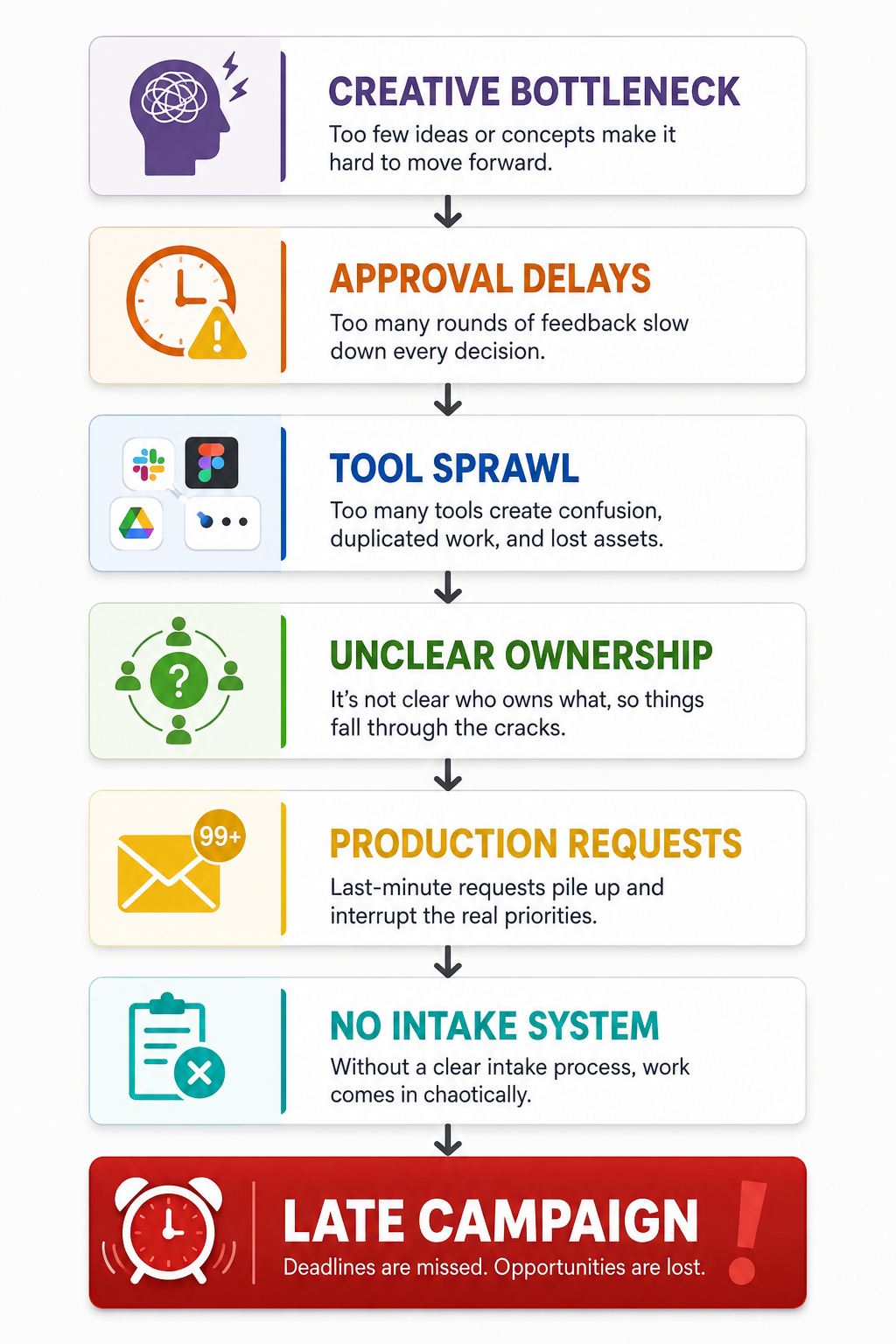
Workflow Killer 1: The Approval Chain That Never Ends
Approval theater is the practice of routing design assets through stakeholders who are included for political reasons rather than operational necessity, which inflates review cycle times without improving output quality.
Workflow platform research consistently shows that marketers at many organizations spend a substantial share of their working hours managing reviews rather than creating. The cost accumulates across every campaign that goes through a six-person approval chain for a social media banner.
For teams where approval chains are the primary creative bottleneck, the most effective single intervention is a defined approval matrix created before the campaign begins. Each asset type gets a maximum of two approval stakeholders for standard marketing assets outside regulated or client-facing categories. Enterprise environments, regulated industries, and agency-client relationships may require additional approvers as a contractual or compliance necessity. Anyone outside the defined matrix receives a notification, not a review request.
Workflow Killer 2: Tool Sprawl Across the Design Workflow
Tool sprawl is the condition in which different stages of the design workflow, including briefing, execution, feedback, file storage, and status tracking, live in separate platforms with no shared visibility or handoff protocol.
Many marketing teams manage creative work across six or more separate platforms. Briefs in one document tool. Feedback in email threads. Files in a cloud storage folder. Status updates in a messaging app. Revision history in a spreadsheet. When the workflow is fragmented across platforms this way, designers spend time locating the current brief, confirming which file version is approved, and tracking feedback that arrived across three channels simultaneously.
Tool sprawl also creates invisible rework. A designer acts on a brief superseded two hours earlier by an email no one forwarded. An approver signs off on a version that was already replaced. These errors compound because there is no single source of truth for the project.
Workflow Killer 3: Unclear Design Ownership
Unclear design ownership is the condition in which no single person or function is accountable for design intake, prioritization, and delivery, which means every stakeholder has equal access to the designer's time regardless of business priority.
According to Superside's Overcommitted: 2025 State of Creative Teams Report, 70% of creatives are assigned work below their skill level. This is not because those designers are underqualified. It is because unclear ownership means the sales team's last-minute request competes equally with the brand team's campaign launch. Without a defined intake process, every request arrives at the same priority level.
When design has no owner, your highest-leverage designers become a reactive help desk. The structural fix is a named design lead or a defined intake process that every request passes through before it reaches the designer.
Workflow Killer 4: Repetitive Low-Value Requests Consuming Senior Design Time
Low-value request flooding is the pattern in which execution-level tasks, including resizing assets, swapping dates on flyers, and reformatting slides, consume the majority of a designer's available hours, leaving no capacity for strategic brand work.
This failure is quiet. It does not look like a creative bottleneck because the designer is always busy. But not busy on what matters. When a senior designer spends three hours reformatting a presentation that a junior resource or a dedicated execution layer could handle, the business receives formatting work when it needed brand-level thinking.
The Superside report found that 85% of creative leaders say they need to do a better job of outsourcing lower-skill execution tasks so that senior designers have capacity for work that requires their expertise. Resolving this requires separating design requests by complexity tier before they reach the designer and routing production-level work to a separate execution layer.
Workflow Killer 5: No Structured Intake System for Design Requests
Absent intake infrastructure is the condition in which design requests arrive through informal channels with no standard brief, no priority classification, and no defined turnaround expectation.
Without a structured intake system, the loudest stakeholder jumps the queue. Campaigns launch late because the design request existed only in a messaging thread nobody pinned. Designers context-switch constantly because there is no agreed sequence of work.
A structured intake system has four components: a single submission channel, a standardised brief template, a priority classification with defined response times, and one person accountable for confirming receipt and estimated delivery. This does not require expensive software. It requires consistent enforcement.
What a Fixed Design Workflow Looks Like in Practice
The Shift From Reactive to Structured Design Operations
A structured creative workflow separates three functions that most marketing teams collapse into one: strategy, intake management, and execution. When a single designer handles all three, all three suffer.
The structural model that resolves the Creative Drain Stack looks like this:
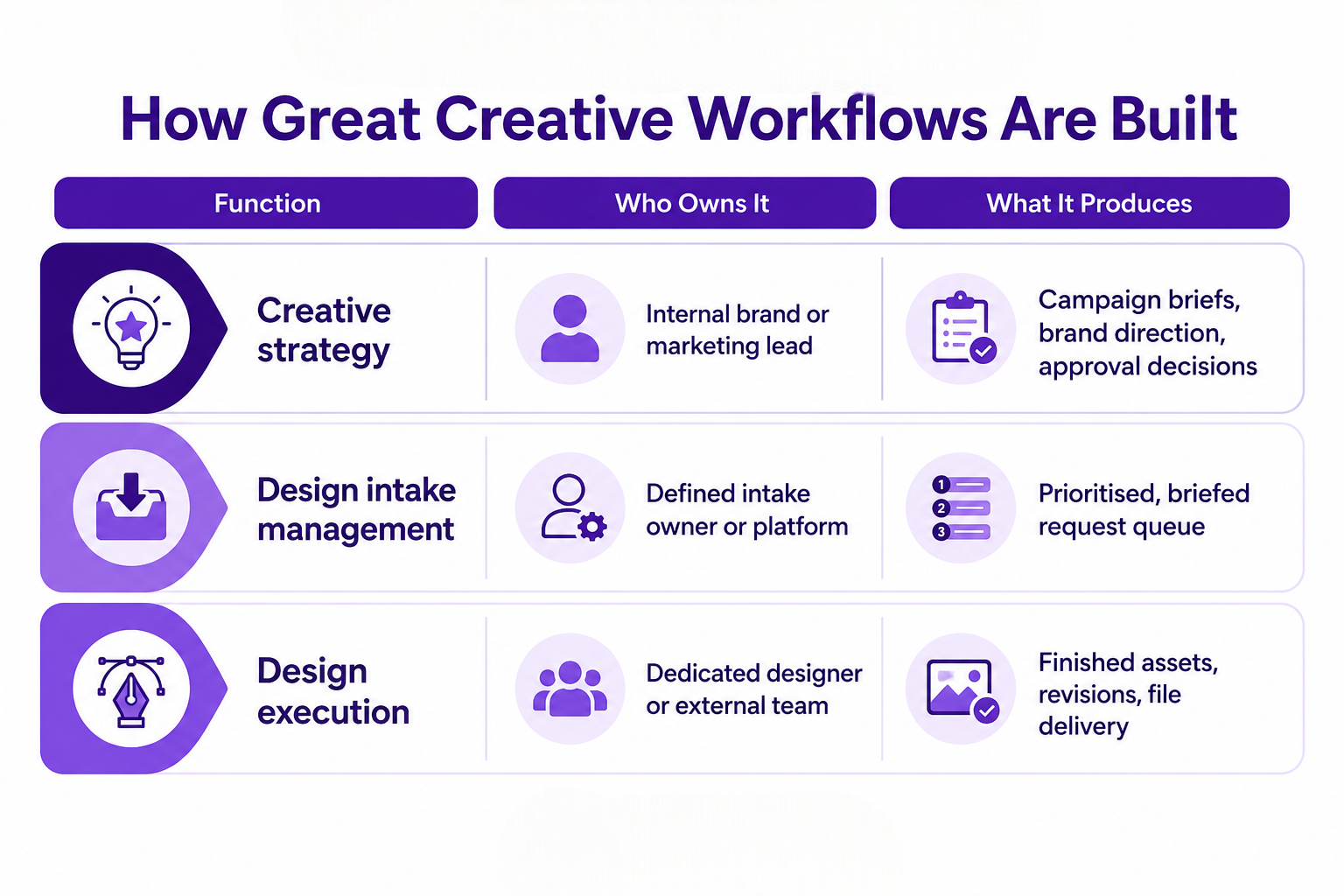
When these three functions are separated, the designer executes rather than manages. The marketing lead directs rather than chases.
Most teams cannot maintain this separation with a single in-house designer because that designer is pulled into all three roles simultaneously. The question is which execution model fits your team's volume, budget, and strategic requirements.
What Are the Alternatives to In-House Design?
Before positioning any single solution as the answer, three models are worth evaluating honestly.
Freelancers suit teams with fewer than eight to ten design requests per month, variable workloads, or specialist needs such as motion, 3D, or illustration that a generalist cannot cover. The trade-off is availability: a freelancer managing multiple clients cannot guarantee same-day or next-day turnaround at peak campaign periods.
Project-based agencies suit teams with large, infrequent, strategically complex briefs: brand identity, campaign concepting, annual reports. The trade-off is cost and turnaround. Agency engagements are priced for strategy, not production volume.
Design subscriptions suit teams with consistent, high-volume production needs where the primary bottleneck is execution capacity rather than strategic direction. The trade-off is limited strategic input: a subscription designer executes briefs. Brand voice and campaign thinking remain the internal team's responsibility.
A design ops manager hire is a fourth option for larger teams where the bottleneck is coordination rather than execution capacity. This is worth evaluating before a subscription if intake management and stakeholder communication are the primary problems rather than volume.
How a Graphic Design Subscription Resolves the Creative Bottleneck
A graphic design subscription resolves a creative bottleneck by externalising the execution layer from the internal team entirely, which addresses four of the five Creative Drain Stack failures: intake becomes structured through the platform, ownership is defined, tool sprawl in the delivery layer is eliminated, and repetitive production work moves outside the team.
It does not resolve unclear strategic direction or approval chain problems that originate at the stakeholder level. Those require internal governance changes regardless of which execution model the team uses.
Design Shifu serves marketing teams, agencies, and growing businesses that need consistent design output at a flat monthly cost. The model works as follows.
One Intake Channel
Every request submitted to Design Shifu goes through a single structured platform. You submit a brief with references and a priority level. Your dedicated designer picks it up. There is no ambiguity about what is needed and no informal back-and-forth caused by an incomplete brief sent through a messaging app.
Unlimited Requests at a Fixed Monthly Cost
Whether your team needs five assets this week or twenty-five, the cost stays fixed. You are not paying per project, per revision, or per hour. Teams that move from per-project billing to a flat subscription consistently cite the removal of budget uncertainty as one of the operational changes that reduces friction in the creative process.
Revisions Without Scope Negotiation
Revisions are included in the model without additional invoicing. For marketing teams running iterative campaigns with frequent asset updates, this removes a recurring friction point in the delivery cycle.
For teams evaluating whether a graphic design subscription fits their workflow, the most important variables to compare across providers are daily active designer availability and revision turnaround time. Monthly price differences at this tier are typically smaller than the productivity cost of a missed campaign deadline caused by a slow SLA or limited designer availability. Brand guidelines fit and onboarding time are also worth evaluating, particularly for teams with complex or recently updated brand systems.
You can also review the signs that indicate your team is ready to outsource graphic design before making a decision.
For a direct look at plans and turnaround commitments, visit the Design Shifu pricing page.
Is a Graphic Design Subscription the Right Fix for Your Creative Bottleneck?
A graphic design subscription resolves a creative bottleneck when the root cause is execution volume and intake management. It does not resolve strategic misalignment, approval governance problems, or brand direction gaps.
Strong indicators that a subscription addresses your specific creative bottleneck:
- Your team submits more than eight to ten design requests per month across all channels
- Campaigns regularly launch late because design assets were not ready on time
- Your in-house designer spends the majority of their time on production tasks rather than brand strategy
- Design requests currently arrive through informal channels with no standardized brief
- You are evaluating a second in-house hire primarily to handle volume rather than specialization
- Your designer is also managing intake, approvals, and file delivery in addition to production
Indicators that other changes are needed before adding execution capacity:
- Your team cannot produce a clear creative brief consistently
- Brand guidelines do not exist or are not enforced at the brief stage
- Design requests are approved by too many stakeholders to resolve without a governance change
- Your primary need is high-concept brand identity or campaign strategy, not production volume
If three or more items in the first list apply and none in the second list apply, a subscription addresses your specific bottleneck. If items in the second list apply first, resolve them at the brief and governance level before adding execution capacity. Adding volume to an unclear brief process produces more assets with the same quality problems.
In-House Design Management vs. Graphic Design Subscription: A Comparison
Conclusion
A creative bottleneck in a marketing team is a structural problem. The five killers covered here, approval theater, tool sprawl, unclear ownership, low-value request flooding, and absent intake infrastructure, form a compounding pattern. Addressing one without the others produces temporary relief.
The right execution model depends on your team's volume, strategic requirements, and brief quality. For teams where production volume and intake management are the primary constraints, a subscription externalises the execution layer and resolves those constraints without adding internal headcount.
If three or more of the five patterns in this post describe your current situation, the problem is not a people problem. It is a workflow problem. Workflow problems require workflow solutions at the structural level.
Book a call to see how Design Shifu fits your existing marketing workflow.
FAQ
What is a creative bottleneck in a marketing team?
A creative bottleneck is a breakdown in the design workflow that causes requests to queue, delays to compound, and team output to fall below demand regardless of individual effort. It is caused by process failures rather than a shortage of talent.
What are the most common causes of creative bottlenecks?
The five most common causes are approval chains with too many non-essential stakeholders, tool sprawl across the workflow, unclear ownership of design intake, repetitive low-value requests consuming senior designer time, and no structured system for submitting and prioritising requests. These compound each other when more than one is present simultaneously.
How do you fix a creative bottleneck in a marketing team?
The structural fix requires separating creative strategy, intake management, and design execution into distinct ownership areas. Assigning accountability for each function and providing a structured intake channel resolves the bottleneck faster than adding headcount inside an unchanged process.
What is a graphic design subscription service?
A graphic design subscription is a monthly flat-rate service that gives a marketing team access to a dedicated designer for unlimited requests and revisions through a structured platform. Requests are submitted with a brief, drafts are delivered within a defined turnaround window, and revisions are included without additional billing. Turnaround times and revision scope vary by provider.
How does Design Shifu help reduce creative bottlenecks?
Design Shifu externalises the design execution layer. Your internal team briefs and approves. Design Shifu's dedicated designer produces and revises. This addresses four of the five Creative Drain Stack failures: intake is structured through the platform, ownership is defined, tool sprawl in the delivery layer is eliminated, and repetitive production work moves outside the internal team. Approval governance and brief quality remain internal responsibilities.
Can a small marketing team use a graphic design subscription effectively?
Small teams benefit from the subscription model when they have consistent production volume but limited in-house execution capacity. The prerequisite is brief quality. A subscription designer executes briefs. Teams that cannot produce a clear creative brief will encounter the same quality problems with a subscription that they encountered in-house.
What are the trade-offs of using a graphic design subscription?
The primary trade-offs are limited strategic design input, a brand voice ramp-up period during onboarding, external dependency on a third-party provider, and the absence of in-person collaboration. Subscription models are optimised for production volume and turnaround speed, not for high-concept brand strategy or complex identity work. Teams with both strategic and production needs may require a hybrid model.
About the author

Sameena is an Organic Growth Specialist and Content Writer at Design Shifu, crafting SEO-driven content that boosts visibility, builds brand authority, and drives meaningful organic growth.