In this blog

Need a design partner that scales with you?
See exactly how Design Shifu can become your on-demand design team. Book a free demo call.
TL;DR
- Graphic design outsourcing means hiring a freelancer, agency, or design subscription to handle visual design work instead of building that capability entirely in-house.
- The three models differ mainly in cost structure, turnaround time, strategic involvement, and consistency, the right choice depends on your design volume and complexity, not just your budget.
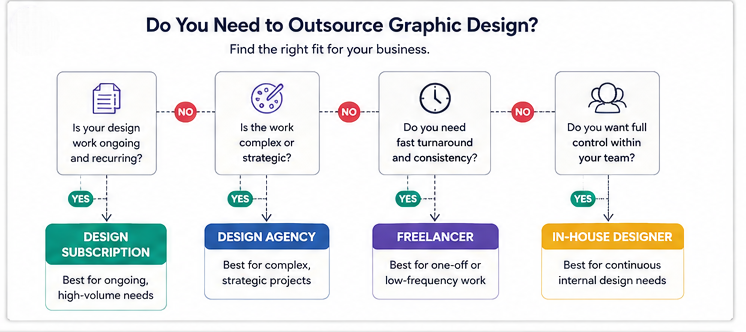
- Freelancers suit one-off or low-frequency projects; agencies suit complex strategic work; subscriptions suit recurring, high-volume production.
- A full-time in-house designer costs more than salary alone once you factor in benefits, software, and management time.
- The biggest outsourcing failures usually come from unclear briefs and missing brand guidelines, not from picking the "wrong" model.
Every business eventually hits the same wall: design requests are piling up faster than one person or one budget can handle them. Maybe you're a founder still designing your own social posts at 11pm. Maybe you're a marketing manager watching a freelancer's invoice climb every time a campaign expands. Either way, you've landed on the same question: should you outsource your graphic design work, and if so, to whom?
Graphic design outsourcing isn't a single decision, it's a category with three genuinely different models inside it, and picking the wrong one is more common than picking the wrong provider. This guide breaks down what outsourcing actually means, what each model costs, how to tell which one fits your business, and how to avoid the mistakes that make outsourcing feel worse than doing it yourself.
What Is Graphic Design Outsourcing?
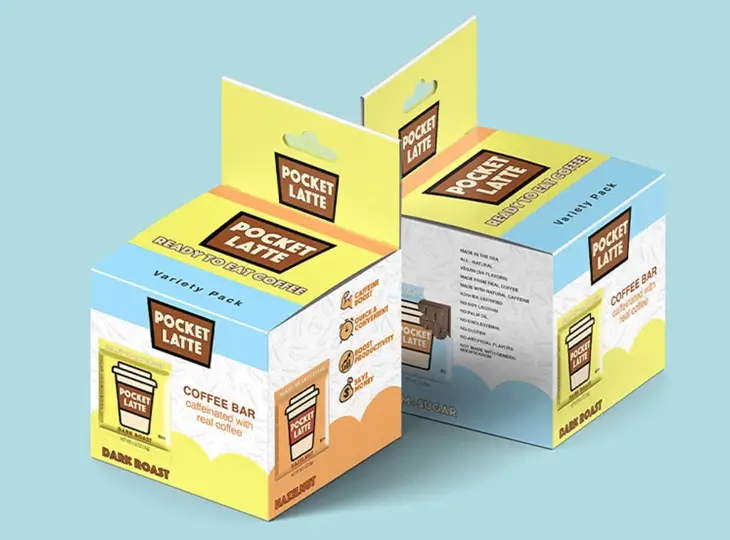
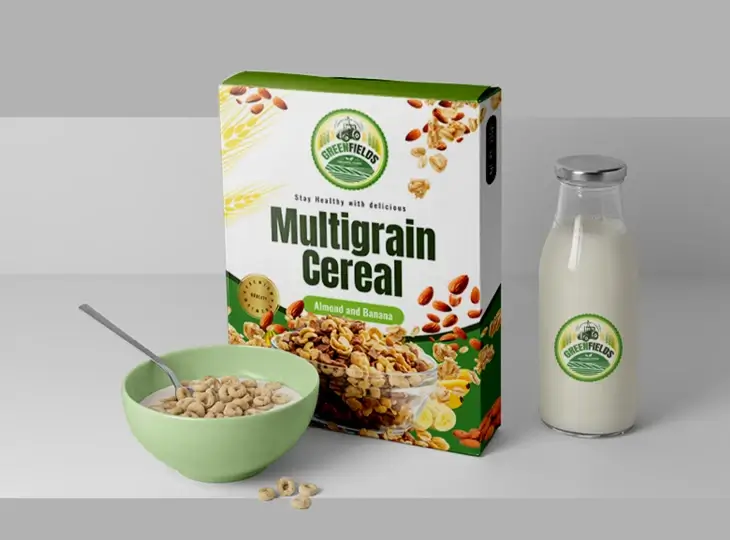
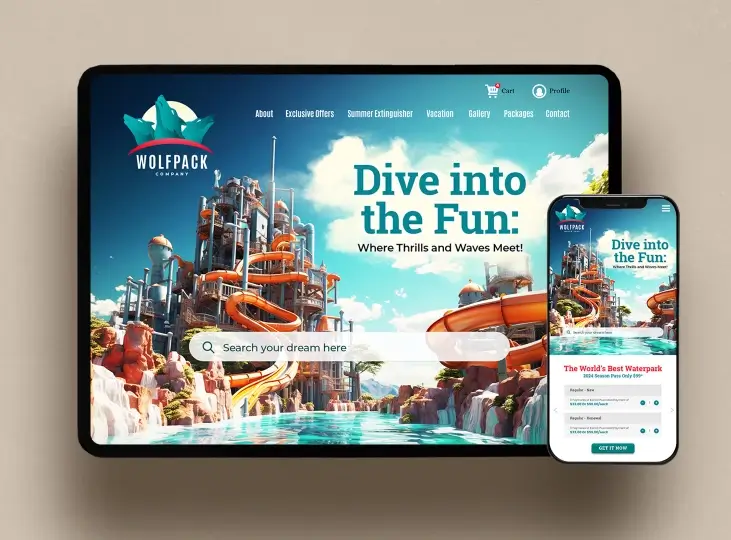
Graphic design outsourcing is the practice of hiring an external person, platform, or company to produce your visual design work, logos, social media graphics, ads, presentations, packaging, web design rather than building and managing that capability inside your own team.
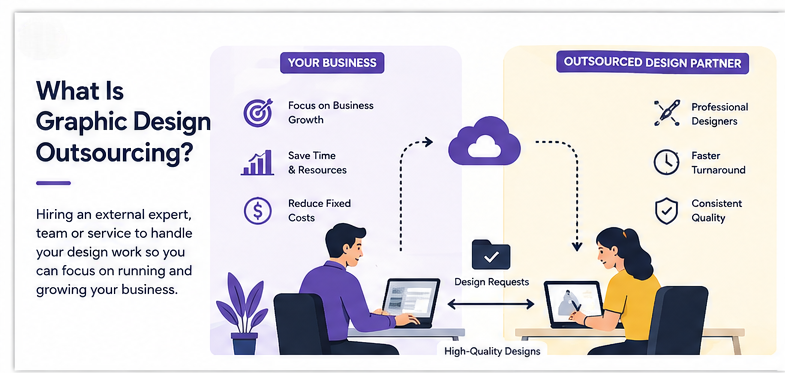
It covers a wide spectrum. On one end, it's a single freelancer you hire for a one-off logo. On the other, it's a flat-rate subscription service functioning as your entire design department. In between, traditional agencies cover everything from a single branding project to a long-term retainer.
The common thread across all three: you're paying for design output without carrying the fixed cost, hiring risk, or management overhead of an employee.
Outsourcing Models Compared
Not all outsourcing looks the same, and the model you pick affects your cost, speed, and consistency more than which specific company you choose within that model.
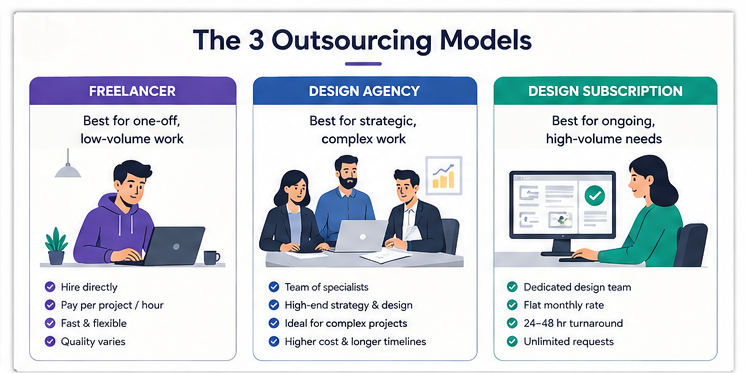
Freelancers: Best for One-Off, Low-Volume Work
Freelancers, found through platforms like Upwork or Fiverr or through direct referral, are the fastest and often cheapest way to get a single project done. You brief one person, they deliver, you pay per project or per hour.
The tradeoff shows up at volume. Every new project usually means re-briefing, re-explaining your brand, and re-vetting quality, because you're rarely working with the same person twice unless you deliberately retain them. Six freelancers across six projects can produce six slightly different visual directions, even with the same brand guidelines.
Design Agencies: Best for Strategic, Complex Work
Agencies bring dedicated teams, senior creative direction, and deep expertise genuinely useful for full rebrands, complex design systems, or campaign strategy that needs more than execution. That expertise comes at agency pricing, and most retainers require a scope and budget that only makes sense for larger, less frequent engagements.
Design Subscriptions: Best for Ongoing, High-Volume Needs
A design subscription gives you a dedicated design team for a flat monthly rate. You submit requests through a dashboard, get drafts back on a set turnaround, and revise as needed without per-asset invoices or re-briefing a new freelancer every time.
This model exists specifically for businesses producing design work continuously: weekly social content, recurring ad creative, ongoing sales collateral. Design Shifu operates on this model, flat monthly pricing, a request queue you can add to at any time, and a dedicated team that retains your brand context between requests rather than relearning it each time.
Outsourcing Models at a Glance
Outsourcing is usually compared across three external models — freelancers, agencies, and design subscriptions but it's worth keeping an in-house team in the comparison too, as a baseline rather than as an "outsourcing" option itself. In-house design gives you the highest level of internal control and availability, while the three outsourcing models trade some of that control for lower overhead. The right choice depends on how much design work you need, how specialized it is, and whether you need execution, strategy, or both.
How Much Does It Cost to Outsource Graphic Design?
Cost varies widely depending on the designer's experience, the type of work, project complexity, turnaround requirements, and pricing model. Rather than treating one number as a universal rate, it's more useful to look at how each model actually prices its work and to be upfront about where a single reliable figure exists and where it doesn't.
Freelancers and agencies price on a per-project, hourly, or retainer basis, and the range is genuinely too wide to reduce to one number — a simple social graphic and a full brand identity system aren't comparable jobs, and rates shift heavily by experience, specialization, and location. Treat any single published "average rate" for either model with some skepticism, including ones you'll find in this article's category.
Design subscriptions are easier to state plainly because the pricing is published and flat. Design Shifu's current plans, for example, run from $549/month (Starter) up to $1,099/month (Scale) at time of writing, each including a request queue, unlimited revisions, and a dedicated team with the number of requests actively in production at once (not the number you can submit) scaling by plan. Since subscription pricing changes over time, always check the current plans directly rather than relying on any published figure, including this one.
Offshore and nearshore providers including many subscription services factor into cost too. Time zone overlap and language fluency vary in ways that hourly or monthly rate alone won't show you, so it's worth weighing turnaround and communication quality alongside price, not just the number on the invoice.
What Does an In-House Designer Actually Cost?
This is the comparison most businesses skip, and it changes the math significantly. According to the Bureau of Labor Statistics' Occupational Outlook Handbook, the median annual wage for graphic designers in the U.S. was $62,960 as of May 2025 and that's before benefits, payroll taxes, recruiting, onboarding, equipment, and software.
Software alone adds up faster than people expect: Adobe's Creative Cloud "Pro" plan, which covers the full app suite most designers need, currently lists at $69.99/month per seat. Multiply that, plus benefits and overhead, across even one full-time hire, and the fully loaded annual cost sits well above the salary line alone.
And a single designer, however talented, is rarely equally strong at brand identity, social content, presentation design, and motion graphics meaning high-volume, varied-format teams often need more than one in-house hire to cover the same ground an outsourced team covers in one plan.
Cost-Per-Asset Is Useful, But Only With Context
Monthly cost alone can be misleading, but cost-per-asset can be misleading too if every asset is treated as equivalent. A better calculation considers:
- Asset complexity — a simple social graphic takes far less work than a pitch deck, landing page, or brand identity.
- Revision volume — two projects with the same number of deliverables can require very different amounts of design time.
- Turnaround — faster delivery can command a premium.
- Management time — vetting freelancers, writing briefs, coordinating feedback, and tracking deadlines all have a cost.
- Specialist requirements — motion graphics, illustration, packaging, UI design, and brand strategy may call for different specialists.
Some subscription providers point to roughly 8–10 design requests per month as a rough industry rule of thumb for when a subscription starts making more financial sense than project-based freelance work — treat that as an illustrative benchmark, not a formula, since your actual break-even point depends on asset complexity and how much time your team spends managing the work. The more useful question isn't "how many designs do we need?" but "what does our current design workload actually cost us in money and management time?"
Signs Your Business Needs to Outsource Graphic Design
You probably need to outsource in some form if:
- Design requests are piling up faster than one person (you, or your one in-house designer) can turn them around
- You're currently juggling two or three different freelancers for different asset types and re-briefing each one from scratch
- Your brand looks visibly inconsistent across channels because different people have touched it
- You're paying agency rates for work that doesn't require agency-level strategy — just consistent execution
- Design is becoming a bottleneck for marketing or sales, not a support function keeping pace with them
If none of these describe you yet — if your design needs are occasional and small — that's a legitimate reason to stay with ad hoc freelance help rather than commit to a subscription or agency retainer. Outsourcing should match a real, recurring need, not be adopted because it's trending. For a deeper walkthrough of these signals, see Design Shifu's 7 Signs Your Business Needs to Outsource Graphic Design.
How to Choose the Right Model for Your Business
The right model depends on several factors: your request volume, asset complexity, need for strategic input, turnaround expectations, budget, and how much project management your team can absorb.
Solo founders and early-stage small businesses usually start with freelancers for a logo, initial brand kit, and first landing page — low volume, one-time needs. Once you're producing recurring content (weekly social posts, regular ad creative), the per-project freelancer model starts costing more in your own time than it saves in cash.
Marketing teams at growing companies often find a design subscription a strong fit when the team needs recurring production across multiple channels — ad variations, social graphics, email headers, and campaign assets — since re-briefing a new freelancer every week doesn't scale well with a marketing calendar.
Agencies and consultancies often use external design services as white-label production support. Most subscription services, Design Shifu included, support managing multiple brand profiles for exactly this use case.
Ecommerce and product businesses typically need a steady stream of product graphics, ad creative, and packaging or listing design — high-frequency, format-varied work that fits the subscription model well, unless the need is genuinely a one-time packaging redesign, which suits a freelancer or small agency project instead.
Enterprise teams needing brand strategy are better served by an agency when the need is a full rebrand, a new design system, or campaign strategy, not just execution — since subscriptions execute well but generally aren't positioned to lead brand strategy from zero.
How to Outsource Graphic Design: A Step-by-Step Process
Once you've decided to outsource, the process doesn't need to be complicated. The goal is to choose the right model, define what success looks like, and give the designer enough context to produce good work without unnecessary back-and-forth.
- Audit your current design workload. List the design work your team needs over a typical month. Separate recurring production work — social posts, ads, email graphics, sales collateral — from strategic projects like rebranding or a new visual identity.
- Separate execution from strategy. Ask whether you need someone to produce designs or develop the creative strategy behind them. Recurring production can often be outsourced to a freelancer or subscription team, while brand strategy and complex rebrands may justify an agency or experienced creative lead.
- Choose a pricing model. Compare the expected workload against each model's total cost — including freelancer management time, agency retainer terms, subscription terms, or the fully loaded cost of an in-house employee, not just the quoted design fee.
- Prepare your brand assets once. Before sending the first request, organize your logos, fonts, color codes, photography, brand guidelines, previous designs, and examples of what you like. Keep them in one shared location your design team can always access — this compounds with a subscription in particular, since the same team works on your brand repeatedly instead of relearning it with every request.
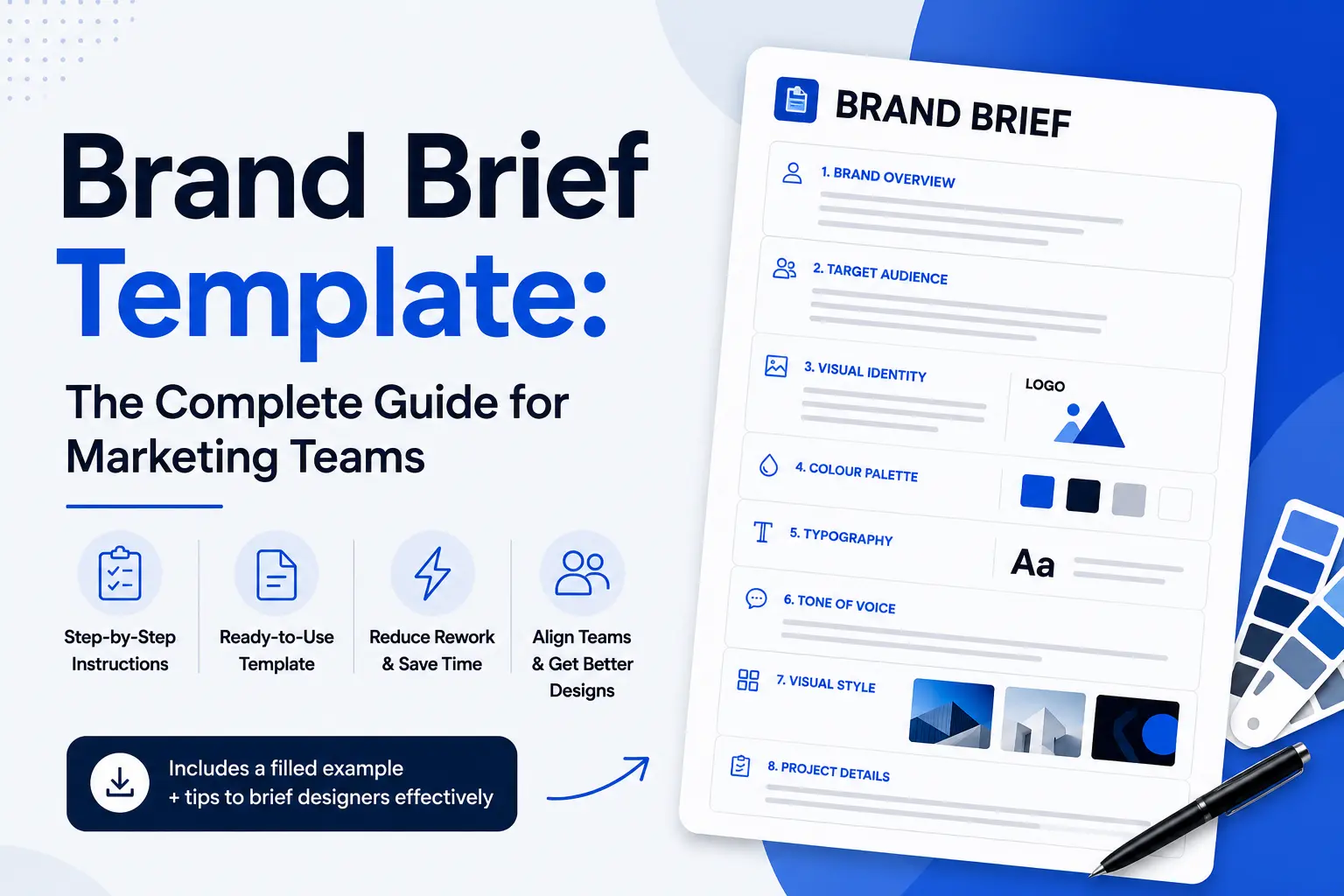
- Write a brief that doesn't need three follow-up questions. Every request should explain the format, dimensions, objective, audience, key message, required copy, brand requirements, deadline, and reference examples. Vague briefs are the single biggest driver of slow turnarounds and repeated revisions, regardless of which outsourcing model you use.
- Start with a realistic test project. If you're evaluating a new freelancer, agency, or subscription service, begin with a representative project rather than your most strategically important piece of work. Evaluate the quality, communication, turnaround, revision process, and file delivery — not just the first visual draft.
- Consolidate feedback instead of drip-feeding it. Decide who has final approval, gather every stakeholder's input, and send one consolidated round rather than revisions one line at a time. This alone is one of the biggest levers on turnaround time.
- Measure the relationship. After the first few projects, review quality, turnaround, revision volume, and total management time. If those metrics are improving, the model is probably working. If they aren't, the problem may be the provider, the process, or the model itself.
Contracts, IP, and File Ownership
Before signing with any provider, get clear answers on three things that matter more than they get discussed upfront: who owns the source files once a design is delivered, whether there's a formal IP transfer or license, and whether an NDA is standard or something you have to request. These vary meaningfully across freelancers, agencies, and subscriptions — a freelancer contract might need to spell out IP transfer explicitly, while some subscription providers (Design Shifu included) build full copyright transfer and NDA-signed projects into every plan by default. Whichever model you choose, confirm this in writing before your first request rather than assuming it's standard.
When Should You Not Outsource Graphic Design?
Outsourcing isn't universally the right call, and it's worth saying plainly where it isn't:
- If your design volume is genuinely tiny and irregular — a handful of assets a year, a subscription or agency retainer will cost more than it saves. A freelancer, or even a well-chosen template tool, is the better fit.
- If your team can't let go of granular creative control — someone who wants to approve every pixel-level decision will find any outsourced relationship, freelance or subscription, frustrating rather than freeing.
- If the work is genuinely strategic, not executional — outsourcing a production team won't substitute for the brand strategy work an agency or an in-house creative lead provides.
Being honest about these cases upfront saves both the switching cost and the frustration of forcing a model that doesn't fit.
Conclusion
Graphic design outsourcing isn't a single choice between "hire someone" or "don't." It's a decision between different ways of getting design work done, each suited to a different volume, budget, complexity, and level of strategic involvement.
Freelancers make sense for one-off and lower-frequency projects. Agencies earn their premium when a project requires strategy, creative direction, or specialized expertise. Design subscriptions can make sense for businesses producing recurring design work who want predictable monthly costs. In-house teams remain valuable when design is a core, continuous function that benefits from deep internal collaboration.
The best choice is the one that matches your actual workload, not the model that sounds cheapest or most convenient on paper. If your business has ongoing, varied design needs, you can see Design Shifu's current plans or browse past client work to evaluate whether the model fits.
FAQ
How much does it cost to outsource graphic design?
Freelancer and agency rates vary too widely by experience, specialization, and location to reduce to one reliable figure. Design subscriptions are more straightforward since pricing is published and flat — Design Shifu's plans, for example, currently range from $549 to $1,099 per month. Always check current pricing directly, since it changes over time.
Is outsourcing graphic design worth it compared to hiring in-house?
It can be, but there's no universal answer. Outsourcing reduces recruiting, benefits, software, and management overhead, while an in-house designer provides deeper internal context and day-to-day collaboration. The median U.S. graphic designer salary was $62,960/year as of May 2025 per the BLS — compare that fully loaded cost (plus software and management time) against the amount and complexity of design work you actually need.
What's the difference between a freelancer and a design subscription?
A freelancer is paid per project or per hour and is typically re-briefed on your brand each time you start a new engagement. A design subscription charges one flat monthly fee and gives you unlimited revisions and an open request queue but the number of requests actively in production at any one time is capped by your plan, not truly unlimited in parallel.
Can I use an outsourced design service for multiple brands or clients?
Many subscription services, including Design Shifu, support managing separate brand profiles within one account, which is why agencies frequently use subscriptions as white-label production support for their own clients.
How do I write a brief that gets good results the first time?
Include the exact format and dimensions, the core message, the intended audience, your brand assets (logo, colors, fonts), and one or two reference examples. A clear brief reduces unnecessary clarification and helps the designer understand what success looks like before starting the work.
When should a business switch from freelancers to a subscription?
Once design requests become frequent and varied enough that re-briefing a new freelancer every time starts costing more in your own time than a flat monthly fee would cost in cash. Some providers point to roughly 8–10 requests per month as a rough benchmark, but asset complexity and management time can move that crossover point significantly.
Who owns the files after an outsourced design project?
This depends entirely on the agreement, it's not automatic. Get IP transfer and file ownership confirmed in writing before the first request, whichever model you use. Some subscription plans, including Design Shifu's, build full copyright transfer and NDA-signed projects into every plan by default.
About the author

Sameena is an Organic Growth Specialist and Content Writer at Design Shifu, crafting SEO-driven content that boosts visibility, builds brand authority, and drives meaningful organic growth.